Thursday, July 11, 2024

OTN-Transport or OTN-Cross connect, What to choose in modern times?


Fortune favors the brave

1       Introduction:


1.1    Background of the OTN – XC:


In the early 2010s where in most of the areas of the world there was an explosion in the traffic requirement due to rise of data consumption there needed to be a technology that can deal with a combination of IP and traditional TDM at the same time. It was difficult and almost commercially inviable to have parallel transmission network for TDM and IP at the same time. Two parallel networks meant

1.     Higher CAPEX

2.     More maintenance.

3.     More usage of fiber cores or Channels.

4.     More manpower.


Arresting all these issues there was a standard quite similar to the levels of SDH multiplexing but with higher line rates. This technology was termed as OTN, Optical Transport Network. OTN has a similar hierarchal structure like that of the SDH but then there is no use of pointers over here rather it uses overheads. The understanding and the basic operations of these devices were more SDH like and thus were very appealing to the people who are especially in the transmission section of the network and are used to working with legacy, SDH like networks.


The OTN device has one more very unique characteristic and that is, it can aggregate several signals like IP, TDM, FC, HDI, SDI etc. and can line out this from a higher bandwidth line. This line can also be a coherent DWDM compliant interface that can easily be put as an optical channel in a WSS or in a MUX-DEMUX system. Thus, with the availability of one box the problems of multiple signal rates from different sources can be managed and multiple devices are not required for different technology. With the use of the OTN technology the transmission capabilities of a network are made more homogeneous and accommodative towards many technologies. Whatever the client rate maybe, it can be put in a OTN device and these can be aggregated and segregated at the same time.


There is also this good ability to add and drop multiple clients of different characteristics and switch directions of these clients by the introduction of OTN cross connects or OTN switches.

1.1.1   Structure of OTN:


 The building block and the progression from the client signal to the final Optical transport unit is somewhat similar to what is done in SDH. The difference over here is the pointers which is not existent in the OTN framework. However, if we inspect in details then the flexibility of OTN is to a great degree than that of SDH with respect to carrying of traffic. This is because of the flexibility in the number of interfaces that can be carried out with respect to client is much better than SDH.


1.1.2   The OTN Cross connect Device:

The OTN cross connect device or in short OTN-XC is a device that has the capability to have several clients converted to the OTN frame and then switch them to multiple directions. Just like the SDH cross connect this also depends on several unit of cross connections which are in the form of ODU (Optical Data Unit). This is why it is often referred to as ODU cross connect as well. In SDH the cross connects used to happen in the level of VC-12/VC-3/VC-4 and in the OTN cross connect they happen in the level of ODU0, ODU1, ODU2, ODU4 etc.


The ODU-XC consists of line cards that are usually coherent modules of 100G/200G/400G. These can be in the form of cards or pluggable CFP2/QSFPDD on the line cards. In addition it contains the client modules that are grey interfaces of STM1/4/16/64 1G/10G/100G FC etc. There is a back-plane connectivity and a ODU-matrix. This matrix is usually ODU-k (where k can be 0,1,2,3 and 4) or this can also be a ODU-Flex matrix where we can have several combinations of ODU in the system.


Structure of the ODU-XC device


The figure shows the flexibility of the OTN cross connect device in a similar fashion as it used to be for the SDH devices. There is a concept to cross connects that can be translated into trails in the level of topology and network. There can be a protected segment just like the SNCP-I that was there in SDH. Thus in many ways the OTN-XC resembles, operationally, the workings of the SDH cross connect albeit for higher line rates and for multiple client rates.


1.1.3   How the OTN-XC is operationally easy to use

 For a person who is coming from the traditional SDH/TDM background the OTN XC is definitely a  gradual and a comfortable method of evolution. The OTN-XC does not bring in drastic complications for the person who is into planning, provisioning and maintenance of the transmission network, as it is a gradual upgrade of the previous SDH network that was prevalent. Essentially the complications of several protocols and different service types are avoided in the transmission layer keeping it as simple as it can be.


On top of that the OTN-XC can do the same kind of provisioning which is closely aligned with the processes of the erstwhile TDM architecture. This is extremely important when a planning team and an operational team in the system is generally evolving from the SDH architecture. 


2       Challenges with the OTN – XC


2.1    Bulky:


2.2    Heavy consumption of Power:


2.3    Not efficient for point-to-point traffic


Generally, when we talk about wholesale bandwidth providers in the industry most of the nature of their traffic is point to point. The traffic is either between two data center points or specific leas of bandwidth, protected or unprotected across two different endpoints. Realizing an OTN-XC under such a condition is extremely expensive option.

Let us assume that there is a requirement of 4x100G across two points that are 500kms apart. The most efficient way would be to have a Muxponder with 4x100G groomed to a 400G QPSK line.


OTN on Card for Point to Point traffic


As we can see in the figure the Muxponder card provides a localized OTN – XC on a  card function and the traffic can be groomed in one unit and provide the aggregate traffic to the two different points.

The same system can also be used for 800G wavelengths and for 1.2Tb/s wavelengths as well. Here the main thing is that we are saving a lot of Opex when it comes to service delivery and cost by introducing the concept of Muxponder.


2.4    Not suitable for a full packet environment


As we have seen from 2017 there has been a consistent decline in the traditional TDM traffic that used to ride on SDH. Even international connectivity is now no more on SDH but on pure ethernet or IP peering. If we analyze the data from 2017 to 2023 then we will see that today almost 95% of the traffic that is there in the network is IP or Ethernet.

The utility of the OTN-XC was when we had a mixture of clients that were from the ethernet zone and the traditional SDH zone with some elements of fiber channel as well. However, with most of the traffic migrating to IP/Ethernet this mixture is becoming far from homogenous. The ethernet share of the traffic is increasing to a great extent.

This has further led to a thought process which mandates the coherent interfaces of 100G/200G/400G and even 800G to be used as a pluggable in the router itself which totally eliminates the need for the OTN-XC and to some extent even transponders and muxponders. The coherent interfaces can directly interact with the WSS or the Optical line system.

In the later section as we study the IPoDWDM system this is explained better.


3       OTN – Transport system


3.1    Understanding the OTN-TX components:

In order to delve more into the OTN – TX we need to first understand the components of the OTN-Transport. There are many elementary components that comprise of the OTN-Transport and this is what we are exploring in the sections below. 


3.1.1   Transponder:


The structure of a Transponder

As we can see in the picture this is a module where the input is essentially a signal of 100G / 400G and the output is a colored signal of OTU4/OTUC4.

The concept of transponder is slowly getting faded away with the arrival of IPoDWDM devices, which we will discuss later. However, transponder have a very good case where we need to connect third party grey interfaces to an optical line system of the same line rate. Eg. Say all the routers in the data center have 400G line out and this needs to be put on different wavelengths of 400G in the optical line system. Here the routers do not have colored interfaces and we need a device to convert the 400G to a proper coherent OTUC4 that can ride on the optical line system. This is where we take the help of a transponder.


3.1.2   Muxponder:


Structure of the ADM on a Card (AoC)

The picture shows an extension of the concept of Muxponder to a system that can be providing an east-west kind of a topology. The AoC concept is extremely beneficial to use if we know the proper drop points and plan the traffic in a way that it will properly adhere to the traffic matrix with a growth margin. The AoC in a way simulates the multi directional attribute of the OTN-XC in a very compact manner and gets accommodated in one of the slots of the photonic shelf. The AoC can seamlessly interoperate with a OTN-XC on a mesh side and a Muxponder on a terminal site and this can provide a comprehensive way of dealing with networks that have multiple layers. In the later sections it will be more apparent to understand how the traffic can be groomed across different kinds of the networks. 

3.1.4   Transponder/Muxponder:


Layout of a Transponder/Muxponder 


As we can see in the picture here, we have an example of a transponder/Muxponder. Another thing to note down is the 4x100GE realization on a single port. Here we use a concept that is called the fan-out. The fanout takes the advantage of grooming lanes of 100G on a 400G DR4/LR4 mapping. Generally, the QSFP slot of a 400GE takes the LR4/DR4 of 400G. This essentially means 4 lanes of 100G combining to make the 400Ge interface. Now this can be further distributed using a MPO cable and a passive fanout device to 4x100GE separate inputs. However, here the thing needs to be noted that the router should have the 100GE LR1 instead of the conventional 100GE LR4.


3.2    How the protection works?


It may be a common argument from the operator side that the realization of a simple level protection is difficult in the OTN-TX scenario as compared to a full-Fledged OTN cross connect device. There may be arguments that the OTN-XC has redundant mechanisms like the ASON in the electrical level and the SNCP when it comes to 1+1.  As these arguments are true, a point needs to be considered that with the inclusion of more an more electrical protection layers the cost increases drastically. This is because the most expensive component in a optical scenario is the Optical line transceiver. While providing multiple transceiver for the line is a solution to enhance protection but then it increases the cost to exorbitant levels. This is why alternative protection schemes should be envisaged looking at the MTBF of the line transceivers.

3.2.1   OLP Level Protection:


Below is an example of an OLP based configuration on one side of the network. The similar configuration is replicated on the other side of the network also. Please note that since this is using the collector and the ROADM network the OLP mechanism can also be implemented in a network that consists of a WSS Mesh and is not limited only to a network that is traditionally point to point.


With the introduction of OLP level protection we can provide


1.     1+1 protection for multiple number of client services with less cost.

2.     Optimize the number of line coherent interfaces.

3.     Reduce a lot of cost on the footprint by providing the same amount of redundancy on the line.

4.     Provide business services in a converged meshy network with desired amount of protection.


OLP level protection setup with dual collector


3.2.2  WSON (Wavelength Switched Optical Networks)


There would be a lot of demand that is based on multiple restoration if more paths are available in the network. A network that is complex and meshy demands multiple switching paths of the traffic with respect to the availability of paths after a failure event occurs on multiple sections. This also takes into account the availability of resources along the path. A classical way to achieving this in the OTN based network is ASON (Automatic switched optical network) that is based on the GMPLS protocol. A similar extension of this in the layer-0 is WSON. In the case of ASON it is the ODU that is the main unit of switching and there needs to be several electrical options and line interface availability for the switching of the network. This, however, is eliminated in the WSON network.


The WSON enabled network can do multiple level restoration and switching at layer-0 but switching wavelengths. This however needs at least a colorless-directionless configuration in the nodes or best a CDC configuration that makes the switching of wavelength easy for the traffic.


For networks that are metro level and connecting to several of data centers and traffic aggregation points over a region say spanning around 400-500 kms, WSON is a very good solution to provide cost effective services with multiple restoration. Here the requirement of line interfaces are less as there is no O-E-O switching and the cost of the infrastructure is one time.


Example of a WSON Network


In the picture above we see an example of a WSON network that is built out of the CDC ROADMs. There are multiple paths for the restoration of the main path and here three options of the alternate paths are shown. A Thing to note over here is that the WSON restoration paths do not need any additional line interface hardware to be constructed or generated. On the basis of availability, the system will create optical cross connects at the OCh level in the system. These OCH level cross connects will lead to the creation of new paths.

So to summarize when we do the network using OTN-Transport and WSON the following are the advantages of WSON

1.   

1.     1. Economical to implement in the network.

2.    2.  Does the restoration at the OCH level so there is no need for additional hardware.

3.    3. In the event more services are added extra line cards need not be added in the transit as the network is self-healing in the optical mode.

4.     4. GMPLS infrastructure has to be developed only once and not again and again. 


3.2.3   OLP + WSON


As we know that GMPLS restoration has its challenges or restoration times that can exceed the limit of 50ms. This is the reason why in ASON also we combine it with the protection of SNCP where there is a pre-provisioned protection path so that we have 50ms switching always.  In the case of WSON also we can combine this with OLP protection, and this can provide the 50ms switching always.

In the ROADM-CDC sites we need to ensure dual collector and ensure that the OLP connectivity is done properly along the lines. In case we use the CDC-collector, this will be better as we will have more flexibility in the wavelength re-usage in the whole network.


In the OLP+WSON mechanism we have complete end to end protection mechanism that is carrier grade in nature.


4       The trend to choose OTN- transport over OTN-XC


4.1    Comparison over cost and power


1.     The OTN-XC for a 400G lambda is 3 times as costly than the OTN – Transport.
2.     In case we are introducing ASON in the OTN-XC then the cost jumps 6 times.
3.     Power consumption is 4 times in the OTN-XC than the OTN-Transport.
4.     With ASON the power consumption is around 10 times more for the OTN-XC.

5.   As we increase the lambdas from 400G to 800G the cost even goes up.


CAPEX and Power consumption is extremely high as we go more towards the OTN-XC. Here this is the case because there will be expansion on the line side and the client side separately. On the other side there will be a good amount of increase on the line side when ASON is added. OTN – XC expansion will create more number of cards and line modules. In addition, it will increase the load on the matrix and the cross connect. These more modules and more number of processes increase the power consumption to a great deal.


4.2    Comparison on Space and Density:


Blending the OTN-Transport and the OTN-XC making an efficient solution


The figure above represents a comprehensive device for the OTN-XC and the OTN-Transport blending. For the present case of services which the customers have, especially in the region of wholesale bandwidth and providing bandwidth as a service, this model can be extremely efficient based on services.

5       IPoDWDM (IP over DWDM)


How the combination of transport and IP is in most of the cases today


The figure above was pertinent if there is a proper mix of the TDM clients and the IP clients. TDM aggregation coming from the legacy TDM mux while the IP clients coming from the IP interfaces. Both of them merging to the OTN-XC and then further the OTN-Wrapping is done to take this over the optical line system. Here we have a complete segregation of network and services. There is a layer of TDM, IP, OTN and Optical separately.

Today, however, the situation is different. The number of TDM-Mux in the network has reduced substantially and there is a good amount of increase in the IP-Traffic in the network. Most of the services are IP oriented so the relevance of the TDM device has reduced considerably. On top of that the bandwidth requirements have increased to a great extent. The need is thus of a router that can have line interfaces as coherent line.


How the IPoDWDM is setup


In the IPoDWDM structure we are able to groom the services of IP on a line that is coherent in nature. This line can be C-band or L-Band and thus can be integrated directly to the Optical Line system. Here, the OTN-XC and the OTN-Tranport both are eliminated from the network and the network becomes even more economical.


The carriage of the legacy bandwidth of TDM can be done over CES, Circuit emulated service. The CES can carry E-1, STM1/4/16 over encapsulation when needed and the IP services go as it is.

The line interfaces can be 100G/200G/400G coherent. The protection can also be based out of LDP-FRR and other IP protection mechanisms.


6      Conclusion


1.     OTN-Transport solutions involving transponders, muxponders, compact-modular serve to be much economical and efficient ways of delivering bandwidth especially in a wholesale bandwidth scenario. 


2.     OTN-Transport solutions have much higher densities, especially when we go to the options of compact modular to delivery high amounts of bandwidth with better efficiency. 


3.     The protection mechanisms and the reliability of the network is hardly compromised with options like OLP and WSON also in the offering. 


4.   The deployment ease and upgrade in an OTN transport network is much higher than the OTN-XC.


5.     IPoDWDM devices can be a better option considering the futuristic growth of the network. 


And Finally:

      So friends, fairly long article and the article is put up after a lot of research and observation. Hope all of you will like it. Please comment, share and like.... 


Cheers, 

Kalyan.....


Thursday, May 2, 2024

Colorless Directionless Contentionless ROADM Networks

Introduction:

Often when we are looking at the DWDM networking we come across the terminologies of CDC. The full form of CDC is Colorless-Directionless-Contentionless. However, transmission engineers who are relatively new to the industry and telecom engineers in general who are exploring the world of the DWDM transmission do not really comprehend the CDC in the essence that it is.  

Few doubts that come in mind are.

DWDM is always colored, so what is colorless?

What is directionless, when we know that traffic is essentially directional?

Last but not the least, what is this term contentionless?

When I was a rookie in this field I also had the same questions and I would like to properly address that for people who are still trying to explore this idea of CDC. 


So let us do step by step dissection of this mystical world of ROADM networks.

ROADM = Reconfigurable Add Drop Multiplexer


 Exploring the ROADM


Before we dive deep in to the CDC level we need to understand what is ROADM. ROADM stands for reconfigurable add drop multiplexer. Essentially in a DWDM network this is an advance version of OADM where you can actually program the channels and frequencies that you want to add and drop in a particular location.

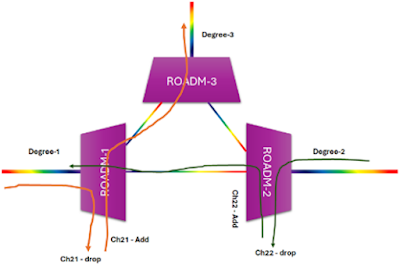
In the figure we are seeing a 3degree ROADM configuration in its most simple arrangement. There are three ROADMs in an optical junction points and these are connected to each other by means of express ports.  The configuration is made such that Channel 21 comes from degree 1 and is dropped over there and the same channel 21 is rerouted as an add towards degree 3.

Similarly from Degree 2 there is a channel 22 coming and dropping and this is added and rerouted to Degree-1. 


General 3 Degree ROADM Site
General 3 Degree ROADM Site Configuration


This is a very simple arrangement of the ROADM and the optical cross connects are created in the ROADM in the similar fashion. 


While everything seems very simple there are certain operational challenges to this configuration that needs to be addressed. 

Suppose the channel 21 now needs to be nor rerouted through degree 3 but through degree 2 then there needs to be physical presence of an engineer on the site to change the ports. 

As all the channels drop through a Mux-Demux port there will be need to physically be present on the site and change the port allocation. 

Similarly if the same Channel 21 needs to be rerouted to say Deg-3 and Deg2 this will not be possible because the port on Deg-1 for channel 21 has already been reused. Thus this will prevent any sort of channel reusability under such optical junction points. 


What are the things that we are missing out over here?

1. We are always mandated to have a physical presence of an engineer on site in order to do manipulation for port add and drops. 
2. It is not possible to reuse the channels in case we want to do that for efficiency. 
3. The flexibility is less in such kind of configurations. 

Directionless Configuration

In order to mitigate the some of the drawbacks of the simple ROADM configuration we have something called as the directionless configuration. The directionless configuration allows the a particular channel to be rerouted or reprogrammed to any direction across the degrees without the presence of an engineer on site. Let us explore how the directionless configuration actually looks like. 

Directionless Configuration

The figure here shows the directionless configuration. Here we are solving one problem and that is not to invest any physical resources to route the channel from one degree to another. As we can see there is a ROADM termed as ROADM-D. This is connected to a Mux/Demux that is having one input of Channel 21. Because we also have the ROADM-D we are able to re-route the channel 21 without any presence of a person on site to change the ports. Hence the channel routing is now a bit more centralized. 

As you can see over here that in order to manipulate the direction for Channel 21 add and drop there only needs to be manipulation in the optical cross connects in the ROADM. This can be done centrally. 
The directionless configuration works well but then it has its own drawbacks for which it is now become more of an obsolete configuration. 

Which problems are not solved by the Directionless Configuration? 

As I mentioned above that there are some problems that are not solved by the directionless configuration eventhough the manipulation of directions can be done by centralized routing. Let us explore these problems over here. 

1. While it is clear that channel 21 is sorted, if the requirement comes to change the channel of the path say the same transceiver now needs to run on channel 22 then in order to make the changes there needs to be a physical shift on the mux demux port on site from channel 21 to 22. 

2. We are not seeing the benefit of a frequency reusage or a channel reusage over here. In the junction point if I have to send Channel 21 in all the directions simultaneously then I will not be able to do so as my Mux-Demux will have only one port of Channel 21 and not multiple ports of the same channel. 

Colorless-Directionless (CD) configuration:

We saw how partially we could mitigate the physical presence of engineers on site with the directionless approach. However, this was only solving the problem to a small extent. Networks have much bigger problems and there will be more number of junction sites in the network that will need manipulations of channels more often than not. In order to mitigate some of these aspects we have the Colorless and Directionless approach that is taken. 

In the CD configuration we use a ROADM on the site that is apart from the degree and this is called as the collector ROADM.  The collector ROADM has a combination of Degree ports that connect to the degree ROADMs and client ports that can directly connect to a tunable client in this case.


Colorless-Directionless Configuration

The best part of the client port is the fact that they can be tuned centrally to any channels/wavelengths that we want. So if a particular tunable interface decides to change the wavelength of transmission from say channel 21 to channel 22 all we need to do is to manipulate the client port wavelength configuration centrally and the optical cross connect centrally.  

A point to be noted over here is that two of the client  port of the collector ROADM cannot be of the same frequency of wavelength. 

As we can see in the figure that now since the client port is tunable we can route any color to any direction without having any physical presence on the site. 

To understand this simply let us take an example.  Suppose port 1 of the client of collector ROADM-C is connected to a tunable interface of say channel 21. Now due to the fact that the collector ROADM is having properties of optical cross connects we can divert this channel to any direction or any degrees.  This is purely the directionless principle. Now say the user decides to change the wavelength of the interface from channel 21 to channel 22. In the case of Directionless we would have to move ports on the Mux-Demux and send a physical engineer, however in the case of CD we just need to change the color of the port connected to channel 22 (Assuming channel 22 is not used in any other ports of the collector). This prevents any physical presence of the person on the site. 

What are we not able to achieve from the CD Configuration?

For the medium sized meshed networks CD configuration solves most of the problems of centralized control of optical cross connects and channel re-routing. However, there is one case, which is apparent in the case of highly meshed networks that the CD configuration is not able to solve.


Suppose we have three interfaces on the site of add and drop and the following case applies.

Ø  Interface 1 wants to send to degree 1 on channel 21

Ø  Interface 2 wants to send to degree 2 on channel 21

Ø  Interface 3 wants to send to degree 3 on channel 21


Now we have a problem with the CD configuration. All these three interfaces need to be channel 21 but the collector ROADM can have only one port with channel 21. How are we going to achieve this?


Can multiple collector ROADMs handle this problem? 

A layman way of achieving this would be have multiple collectors. So let us have a look at the figure what happens when we have multiple collectors. In this we have ROADMC1 ROADMC2 and ROADMC3 as three collector ROADMs in the drop site. As impractical as it may seem to be let us have a look at this for understanding. 

Because now we have three collector RAODMs we can reuse the same channels in three collectors and connect our interfaces to different collectors and get them sorted. We will need to create separate optical cross connects over here and this will ensure that the directions are routed appropriately and the frequency reusage is done.  Here there will be central control as well and there will be reusage of frequency in these junction points. So in a way we have been able to solve the problem of the channel reusage which was not mitigated in the CD configuration by adding multiple collectors. 


Channel re-usage using multiple collectors

Although we have solved the problem the question that we need to address is much bigger over here.  And the questions are written as follows.

1.       Is this a practical solution?

2.      What happens when I need to add one more degree to the site?

3.      If I have many such junction points in my network what would be my ROADM investment? 


Well, the answers of these question are tough and definitely the solution is not scalable and commercially feasible let us see how. 


Why the multiple collectors will not work after a particular point?

The multiple collector solution is assuming 1:1 provisioning of collectors per degree ROADM. So a site with say 7 degrees will have 7 collectors in order to achieve the channel reusage function. The channel reusability will then cost the provider a huge amount of cost and heavy footprints considering the network. Also the sites will become bulky and meshy as each collector needs to be connected to all the degree ROADMs that we have. As the number of degrees increase and more number of such sites come into existence this solution becomes awefully expensive and non-viable.


Colorless - Directionless - Contentionless (CDC):

From the CD configuration we have only one drawback to mitigate and that is the channel reusage in all the directions. We tried to do the multiple collector arrangement but then the solution seemed to be non-viable with respect to scale and numbers of a network.  So what we need is a kind of a collector ROADM that is having the internal cascading of many collector ROADMs at the same time. Basically it is an internal ROADM switch that allows to have same channel configuration on different ports ad the same time.

CDC Configuration

This kind of collector ROADM is called the contentionless ROADM.  In the figure that we are seeing we have a collector ROADM which is called as ROADM-CN. This is a kind of contentionless ROADM.  Here we can see we can have many client interfaces with the same frequency aligned.

While it is easier said than done the contentionless ROADM is coming with a lot of complexities inside. Technically a Contentionless ROADM collector is a MxN ROADM where there are N number of collectors with M number of degrees. So the ROADM internally is a collection of many ROADMs and is a kind of a switch. However, the contentionless configuration actually enables the ease of operation to a great degree especially in the field of dynamically changing networks. 

Comparison of different kind of configurations


Now that we have an idea of ROADM sites, CD and CDC, let us make a small analysis in terms of a table as to what configuration is to be used where.


Aspect

Normal ROADM

CD Configuration

CDC Configuration

Cost

$

$$

$$$$

Complexity

Simple

Moderate

Complex

Flexibility

Limited

No frequency reusage

Fully Flexible

Type of sites

Can be used for 2D or in some cases even 3D sites which have less channel re-route

Recommended for 3D – 5D sites with moderate traffic and channels

Recommended for a high mesh 5D onwards with higher possibility of traffic rerouting.

Centralized management

Physical presence needed for change of channels or ports

Can be centrally configured

Can be centrally configured.

GMPLS*

Difficult to achieve

Supported

Supported


Summary: 

In order to understand what configuration is suitable to your network it is very essential to make a proper planning of wavelengths. Proper wavelength planning and keeping room for the future makes it very easy to ascertain what technology to go for and in which node.

Most of the time it is at the planning stage where we need to decide if we go for the CD configuration or for the CDC configuration. Depending on traffic, flexibility and multiple add-drop points we need to make this decision. 


Cheers

Kalyan 


Sunday, December 30, 2018

Understanding UNI (User Network Interface)

Dear Friends, 

The year 2018 is coming to a close and this is the right time to write something on request of somebody. I had provided an article explaining Provider Bridge and Provider Edge concept where I touch-based upon the aspects of bridging and tunneling. Well I believe the article needed a prequel and that was to understand the different interface types that we have in the data networking. 

The networking that we do for data services are very dynamic and there can be several combinations of port-types and service types with domains realizing one important aspect and that is to carry the traffic from one point to another with reliability, security and prioritization. 

There are two kinds of interfaces that we have

UNI ----- User Network Interface
NNI ------ Network Network Interface. 

Today my post will concentrate only on the UNI aspect as I do not want to make this a very lengthy post. People may get grossly bored to read a lengthy post as for one I have noticed, the new generation lacks some kind of patience. 

What is UNI? 

In a very short and crisp definition we can say that UNI is the interface that connects a customer to the network. UNI port is an entity of the provider, however it interacts with a customer port or an interface. Please note that I have mentioned the terms port and interface separately. The reason being that a particular physical port may carry several logical interfaces that may be of UNI nature. 

Figure-1 Representation of a UNI


The figure above visualizes the definition of UNI. 

However, the concept of UNI is deep and needs more elaboration. For this we need to understand the concept of VLANs. A VLAN is a concept where we can break the broadcast domains to different smaller domains without involving the routing. You must be knowing that a switch breaks collision domains and the router breaks broadcast domains. However, what can be done in order to break a broadcast domain within a switching network without involving routers is to use VLAN. 

The VLAN gives a kind of identification to the packet or frame that is coming to the switching device as to which service that is should follow. VLANs are of 4 bytes and that are appended to a standard 802.3 frame. 

We see the structure of VLAN below. Disected. 

Figure-2 Dissection of the structure of VLAN

The VLAN is appended in the frame and it is providing the identification of the frame to follow a service. Here the main important thing is to see how the VLAN is appended in the frame. The frame can be untagged (without a Vlan) or it can be tagged (with a VLAN ID). Basis on this we have the two different types of interfaces of UNI. 

Figure-3: Types of UNI port

The types of UNI are the the basis of how the VLAN is treated in the service and the traffic is mapped. This is the thing that we will see in detail below. 

1. Access UNI port:

Imagine a situation where there are three customers who are all sending untagged frames. However the WAN which is carrying the traffic is a common WAN. How are we going to segregate this traffic. There is one way to do it by leaving it on the Mac Learning and bridging concept. The concept over here is that every device will have a different MAC and based on the MAC filter there will be communication and we will have one common LAN. However, this aspect has some disadvantages. 

Figure-4: Situation where three customers carry different traffic


> What happens in the unlearned state? 
> How will the traffic be treated? 
> What happens if one customer is sending a broadcast? This will affect the performance of all other customers. 

However, we cannot impose the condition on the customer to tag these frames. If we do that we are putting conditions on the customer and this way we will have to put similar conditions on all other customers, which is not a good idea. 

Here the thing is to have an access UNI port. 

The access UNI port accepts an untagged port on the LAN and then appends the VLAN on the frame of customer and then forwards it to the WAN. 

The flow is explained in the figure below. 

Figure 5: How the access VLAN UNI works

Here you see that the customer 1 sends the untagged frame and then it reaches the access port. Here the access port adds a VLAN ID to the frame and this travels through the WAN. On the other side when the frame is coming out the VLAN is matched and stripped and the original frame is received by the end. 

Points to note: 

1. Access VLAN ports in the UNI append VLAN in the ingress and match and strip the VLAN in teh egress. 
2. This action is like attaching a unique envelope to the untagged frame and taking it out on the other end without distorting any information. 

In our case we can have the following scenario for our three customers. 

Figure-6: How the three customers will be segregated


Here we see that every customer is connected to a different access port and so we put the access VLAN accordingly to identify the customer. Also note that the customer 2 may have a different drop point than customer 1 so this has to be organized in that way. 

2. Trunk Port: 

Once we understand the Access VLAN port functioning understanding trunk port is very easy. The trunk port in this case is our WAN. The WAN port is not adding or stripping any VLAN however it does a validation of VLAN that it has to pass. In our case we will put a validation that the trunk link should only pass VLAN 100, 200 and 300. 

The algorithm is the trunk port accepts frames that are already tagged and then matches them with the validation. Based on that it forwards. 

So friends, this is about the UNI port. We shall see the functioning of the NNI port in a later post. Understanding the UNI interface is very important in order to do selection of interfaces in data traffic planning. Therefore, be careful in deciding the same. 

Till then have a fantastic New Years' Eve.... 

Cheers and a Happy New Year, 

Kalyan 


Tuesday, December 25, 2018

RSTP/MSTP Part –V How does switching take Place in RSTP and MSTP?


 Dear friends of the Telecom Fraternity,

I was writing a series of RSTP in 2013 and possibly, there are many things to catch up. I would like to divert your attention to this blog that was the fourth part of my RSTP series.


It is from this blog we continue our journey ahead to this vast topic called RSTP. Generally, people believe that RSTP is for switching, but I had clarified before that this is a Loop avoidance Mechanism. RSTP makes the switching of services in case of Failure more salient because there is a transition of paths.

In this section, we will concentrate on a simple architecture and that is RSTP Ring. As explained before we optimize the ring with a selection of optimal blocking port in the service.
Figure-1: RSTP ring topology example


Now in this ring let us understand that there is a service from the root Bridge to N-2 with SVLAN 200 and another service from Root Bridge to N-3 with SVLAN 300. This can be shown in the figure below.
Figure-2 Service configuration in the RSTP domain


To understand the concept of service switching let us understand a failure scenario. So in our case we imagine that the link between N-1 and N-2 has failed. Definitely, the service will be routed from another direction. However, in our case we will see this in a step-by-step basis.  Please remember that a service switching in RSTP is not as simple as it looks. Because there are no predefined main and protection paths like you have in TDM or MPLS. Here the entire switching of the service from one direction to another is working broadly on two principles.
  1. RSTP Re-convergence
  2. Mac Learning renewal at all switching points. 

We will see all these happening but you have to remember that all these happen very instantly. Typically the re-routing time of the services in the event of failure in RSTP is 200ms. Note this is not 50ms and that is why it is not recommended to run voice services or any real time services involving voice in the RSTP network. This is the reason why RSTP is regarded to be a Non-Carrier grade method. However, for a normal http service or a https service it does not matter as there is a TCP retransmission always happening and so RSTP works very well.

So we see the figure below to understand the failure scenario. 

Figure -3 Failure Occurrence in the link


 After this failure has occurred the first thing that happens is that N-2 does not get the BPDU packets from the N-1 (its designated bridge). So a Root port transition takes place and the link that is between N-2 and N-3 becomes a forwarding link. One special thing to remember over here is that in the N-2 to N-3 link, which is the blocking one of the ports between N-2 and N-3 will be the discarding port. RSTP in this case will not have two discarding port. So we have two cases over here. 

1. In case the discarding port is N-2 and there is a Root port failure on the N-2 then the Topology Change request of RSTP will immediately come into action and N-2 discarding port will turn to forwarding. 

2. In case the discarding port is N-3 then the TC message is communicated from N-2 to N-3  and N-3 changes the port from discarding to forwarding. 

Here the critical part is the topology change notification message that is carried by the BPDU and this always happen after a minimum hold-off time which is 200ms. The difference between STP and RSTP is over here. In STP there is a wait of three hello intervals which makes the initiation of TCN happens delayed. This results to a switching time that is more than 3 seconds. However, when we talk about RSTP (Rapid Spanning Tree Protocol) the TCN notification are subject to port transitions in any switch. Therefore N-2 and N-1 will both have transition changes and will initiate TCN immediately after the expiry of the hold-off timer. 

Now after the TCN is communicated the new state of RSTP will be as the figure below. Please note we have not yet considered how the service is being rerouted, we are still seeing the first part of the switching and that is RSTP re-convergence. 

Figure-4: RSTP topology change

Now the topology change has occurred. But what is remaining still is the re-routing of the service. I told this earlier that RSTP does not have a pre-defined protection and main path so the service re-routing is happening plainly on the basis of Mac Learning. RSTP is a scheme that is used in the case of Provider Bridge networks. To understand what is a provider Bridge network please refer to my earlier blog post in the permalink given below. 


In this blog post you will find clearly how the traffic moves in the provider bridge networks. So as this is a provider bridge we see that for the service affected, which is the service with SVLAN = 200, the mac learning has been done in the following manner of (Root Bridge - N1-N2). Now the path between N1-N2 has failed and there has to be a sort of notification to the root bridge to send the traffic via the other path. 

The self healing way of such a scenario is that the traffic stops and we wait for the expiry of the aging time of the mac table. The aging time of the mac table is a user configurable parameter, however the minimum value is 10 seconds. So technically if such a failure has occurred the service rerouting should take place after 10 seconds (aging time). 

Phew!!!!!! This is long. So the developers of RSTP thought of another approach and this was to flush the mac-table of every bridge that is involved in the RSTP domain. Therefore, the TCN also sends a command to flush the mac-table of all the bridges involved in a particular RSTP domain. 

Something like the figure below. 

Figure-5 Mac-Flush happening n all the nodes involved in RSTP

Here we see that all the points of the RSTP domain are flushed. 

Now it is anybody's guess what will happen after the flush of the FDB occurs. There will be relearning of mac address for the services. In this case the service with SVLAN 300 will have the same path of mac learning but the service with SVLAN-200 will not have the same path of mac learning. Now N-2 which is the destination point will learn the mac via N-3 and not N-1 and this will make N-3 the Designated Bridge for N-2 and the service will now be re-routed. 

Figure-6 Final Re-routing of the service

So here we see a complete step-by-step process of re-routing of the services. Tough but not so tough to understand. 

In this case please note, now the bandwidth distribution in the ring is not optimized and there can be a scene of congestion between the link of RB to N-4 and N-4 to N-3. Under such scenario the QoS will come to play and the RSTP domain has to be properly traffic engineered. 

What happens when the link restores?

Now we saw about the failure the restoration of the link is also treated like a seperate failure in this case. RSTP recognizes only topology changes and now with the link repaired there is another topology change. A similar TCN will pass through the ring and there will be re-convergence and the block port will now be as per before. The TCN will flush the Mac tables of all the bridges and this will lead to service re-routing again. 

So friends, pretty long blog post, but cannot help. In order to understand the switching part there has to be more description, which I have tried to bring in. But, we have just touched the tip of the ice-berg. There are lot many things happening beneath the skin of the water and to dissect it threadbare it would need another 50 blog posts. We will see the operational aspect of RSTP in multiple topology scenarios as well and dual homing cases. 

Till then 

See you.

Regards, 

Kalyan 

Keep thinking!!!! Keep Reading!!!! Keep Evolving!!!!


Tuesday, December 18, 2018

How to do things differently in Telecom?????


I remember the last blog-post that I had written. Telcos do not need engineers. This invited a lot of censure and on the other side showed the mirror of reality to many telco veterans and contemporaries. I had ended the blog by saying what is needed then? Well here I am to make an effort to answer these things.

Change is a continuous process and not that what will be valid today will be valid after five years. Technology changes as we speak and so does the methods to manage technology in a great deal.  So let us understand what are the new things that we should adapt to. I believe the members of the telecom fraternity should have reptilian tendencies these days in order to survive and be a positive contributor of this industry for a long time. We will classify these things as What is In and What is out?


1.    IN: “Work with me”  OUT: “Work under me”
The most critical point of management is the degree of authority. Authority is a responsibility and not just a right of seniority. However when authority becomes dogmatic then there is definitely a problem in the management style. There is an old saying “People join companies, people leave bosses.”; The saying unfortunately is true till date. Instead of this, it is required to behold a sense of "espirit-de-corps" that should prevail across the ranks. Vertical conflicts are a thing of past. Intellectual conflicts are the new things to watch out for. Ideas are nobody’s monopoly and definitely not a privilege of seniority. Therefore it is always necessary to take your juniors with you. Working with has a lot of advantages than making work under.

2.    IN: “Opinions of Juniors” OUT: “Approvals from Seniors”
Another very rebellious statement, but true! Telecom is an industry that is always shaped by fresh ideas. Fresh ideas cannot be expected from veterans of 10-20 years old, unless there is an unbelievable streak of innovation, which is rare in the Indian context. Any fresher that comes to your company is an asset. Not because you can make him/her laboriously, toil over mundane works but harvest new ideas from him/her. A fresher has a lot of imagination because he/she is undaunted by experiential difficulties and obstructions. A fresher or your junior is just scared to speak because of the weight of position that you throw to him/her knowingly or unknowingly. They are not outspoken sometimes because they feel they will be judged. An approval is a formality but an opinion can lead to a breakthrough and this can only come from the new generation. Experiences are good but they are good to guide the new generation and make them aware of the mistakes that had been made in past. Not to scare them with positional authority. Approvals are needed, only for leaves and protocols.

3.    IN: “Affinity for Automation” OUT: “Justifying the Manual Cause”
Times have changed and so have the approaches to a problem. Gone are the days were we needed a lot of manual staff to manage things that are routine. These have to be automated so that the expectations from human resources can be raised. Contrary to the feeling that automation is a killer of human opportunities, I believe it is an opportunity to raise the bar of human involvement in the field of telecom from being grossly mundane to being innovative and creative. Today’s telecom demands innovation and creativity. This has to come from every levels of the organization. For being creative the human mind needs something which is essential and that is time to think. Of course, there is a corollary which says that work keeps humans busy, but definitely mundane work makes them morose and more like zombies who after some years become of no use. Every human asset of the telecom company has to be a generator of creative and productive idea and that is why automation is required to shun the monotony that is prevalent in the industry.

4.    IN: “Leaders”    OUT: “Bosses”
Explained this before and now again explaining it. It has been long this discussion of leaders vs bosses have taken place and the toying of this idea has gained a lot of popularity. Now is the time to implement and evaluate this idea. A leader is a person who gives direction and takes the initiative to walk the talk. A boss on the other side is a generator of instructions and orders. Industry definitely needs leaders. In war-time you need leaders who can take you safe from the cross-fires and inflict minimum casualties rather than a boss who is not on the field and just instructing from a safe haven.

5.    IN: “Evaluating Technical Edge”   OUT: “Compliance”
This is especially to the people who are evaluating vendors or technology for their implementation. Most of the time they are obsessed about compliance overlooking the technical edge. This leads to a lower shelf-life of the network. There will be solutions that are unique in the market and are innovative, processes have to be bypassed for absorbing those. Regular processes make regular companies. To be a company that stands out there has to unconventionality in the processes. Because unconventional evaluation makes unconventional companies. The idea of providing internet through hot-air balloons was not evolved from a telco. Because a Telco always focuses of compliance, obliterating anything that is unique and outstanding. This definitely has to change.

6.    IN: “Process Management”  OUT: “People Management”
This is the generation of the millennials. They are focused. They know what they want and how they want it. They are coming inbuilt with a management guidance system in their personality. They are intrepid and they are also adventurous. They are passionate at times and at times they are totally detached. A traditional people management approach is futile in managing this generation of people. There is a need to accept the fact that this is the generation with most of the ideas and that too the creative ones. They are a treasure and a treasure is not people managed but protected and preserved. So the requirement is to have a process and a management of the process that lets the company and the industry at large harvest from this amazing pools of knowledge.


So there are a lot of things to change. These changes will come. Today it may seem to be a giggle factor or some philosophy in book, but they will certainly come and I am hopeful. I am betting on this change because of a simple philosophy. “If there was somebody who could stop progress and change we would be still living in the caves.”

On that note, I leave you now to decide and comment on this post of mine.

Cheers,
Kalyan


Sunday, December 9, 2018

TELCOS DO NOT NEED ENGINEERS!!!!!!


Yes, you heard it right. Telcos do not need engineers anymore. Infact the engineers that the telcos have are not more than a liability. The engineers, heads, managers, technical team….. a mere cost item, precisely the Right hand side of the balance sheet.

Surprised! You ought to be. I, myself am an engineer in this industry for the last 18 odd years and I am saying that. So why such a change? Why such an iconoclastic statement?

The reason is the definition of “Engineer” that the conventional telco understands is way outdated and way under the requirement. An engineer in today’s telco industry is a person who has to tread a line of processes, forgetting creativity and unconventional thinking. There are sets of ground rules that have to be adhered, sometimes breaking those ground rules is not only a flouting of policy but like a criminal offence.

Result! The same old thing repeating again and again. So called engineers become human robots following monotonous orders and doing the same stuff. Working in this industry in the conventional way does not seem interesting anymore and this affects the overall performance and nature of the company. Every technical staff, of the 100% effort that he/she makes, 90% is devoted to saving himself/herself from something. The attitude that shouts out loud, “I AM NOT RESPONSIBLE” is written everywhere in the company and finally we have “NOBODY RESPONSIBLE” in the entire structure.

The thing that happens is that nothing new comes out of the industry and we have same old services again and again without a shade of change. Scary job environment just mandates one thing and that is to keep your job. The best thing over here is when the planning guy feels insecure he does a charade of taking out a tender as if he/she were to design a NASA space shuttle. Tender process goes on for six to eight months and this is the time the planning guy looks out for another job. The outcome is either the planning guy has moved out to a new company or the tender is postponed for another six months.

Operations is funnier. Sometimes in order to see that they have work, they pray for some fault to come, and when it really comes and they are helpless, they just pick up their phones and make calls to the managed service partner, without applying any significant brains on the problem. As if they were hired in the company to just be telephone operators, they just drain the batteries of their phones and their energy bags shouting at the managed service partner and vendor. Once the fault is fixed, a thank you note to the vendor and a gallantry award from the operations manager who is equally scared of his/her job. Finally, a breather for another three months and life goes on.

IN ALL THIS CIRCUS THE BIGGEST CASUALTY IS THE CONCEPT OF “ENGINEERING”…. RIP

It is much better that such mundane activities are now being outsourced to machines through Artificial Intelligence and automation. Automation today can replace most of the monotonous work in the telecom industry and believe me most of the work is monotonous even planning. Artificial intelligence and automation comes as a boon and not bane. At least if not everything, it shows the mirror to the engineers at all level that they have to be “engineers”, because robots can be made by synthetic things as well.

Well after all this acerbity that I have spat out, I am surely expected to be trolled. After all telling the truth comes with its occupational hazards. However, I have spoken out.

So what is needed? What do we need to do in order to come out of this vicious circle?

Will speak about this in the next article.

Cheers,

Kalyan